




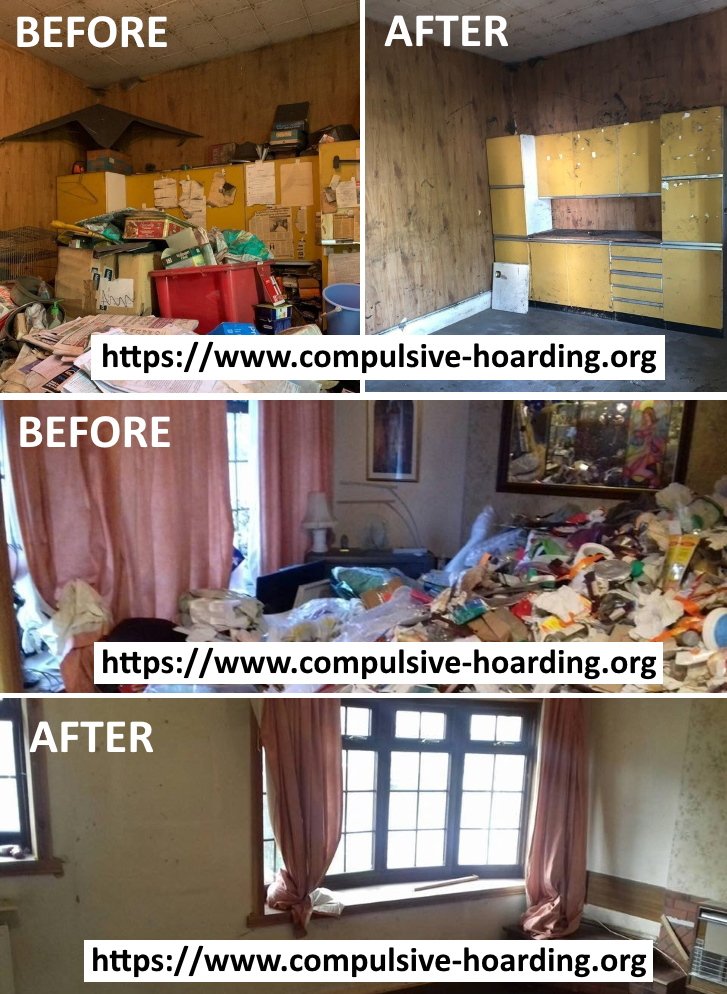
Understanding what makes a compulsive hoarder is not straightforward. The behavior manifests in a variety of different ways. In a nutshell, however, a hoarder is somebody that finds himself or herself unable to dispose of seemingly useless items.
A hoarder is not the same as a collector. It’s not even somebody that tosses things into a spare room or cupboard, then closes the door so they don’t need to look at them.
For somebody to be deemed a hoarder, their home must be so cluttered that they’re unable to perform the most basic tasks. Vital rooms, such as kitchens, bathrooms and bedrooms, will be inaccessible due to excess clutter. Many hoarders will not even be able to sleep in their own bed, as the room resembles a badly packed warehouse. Continued near the bottom of this page.
Clearing a hoarder’s house? The Cluttered Hoarded House Clearance Company offer professional compulsive hoarding clearing services in the UK. Specialists in cluttered hoarder house clearance.
Call us now to discuss your situation, let us tell you how our service works.
The Cluttered Hoarded House Clearance company are fully licensed with the UK environment agency (Environment Agency Waste Carrier License NO #: CBDU284870), we are also members of AFTA.ORG.UK the Anti Fly Tipping Association
I just want to say a huge thank you to the cluttered house clearance specialists who cleared my great aunts extremely cluttered two bedroom town house in Lancaster last week. The team from Cluttered Hoarded House Clearance have done an outstanding job, they worked really hard from start to finish. My aunt who was a compulsive hoarder in her day hoarded everything from magazines, clothing to bric a brac.
Hoarding to Survive
Hoarding has long been associated with survival. Farmers and self-sufficiency enthusiasts, for example, will collate as much harvest as they can in case of a harsh winter. Animals are famous hoarders, too. Think of a squirrel, and their habit of storing nuts for a rainy day.
We mean no offence to hoarders when we make this comparison. In fact, science supports the evaluation. Brain scans performed on human hoarders show very similar activity to those of a squirrel.
Of course, we could all be referred to as hoarders in some respects. The average home will have an excess of batteries, tinned food, light bulbs and candles. We may even keep an old mobile phone, several years out of date, in case of an emergency. Most of these items will never be used. In truth, we probably forget that we have them. They remain useful – some might say essential – items though.
A compulsive hoarder will express similar behavior, but taken to an extreme. They will keep anything that they acquire. Rather than one spare mobile phone, they’ll have several dozen with shattered screens. Rather than a handful of unused lightbubs, they’ll have hundreds that have long since burned out. Rather than tinned food with a sell by date years in the future, they’ll keep long expired perishable goods.
The Manifestation of Compulsive Hoarding
Even if you’ve never encountered a hoarder, or set foot in their home, you’ll still have an idea of what to expect. The media has drilled a picture into our minds. Every square inch of the house will be coated with useless, pointless possessions. If one man’s trash is another man’s treasure, as the saying goes, hoarders are truly opulent.
Animal research experts refer to this level of hoarding as a cache. Again, it’s akin to the squirrel with their pile of nuts. They found these, and they’ll protect them with all their might.
Some people are referred to as scatter hoarders, however. This is the equivalent of cache spacing in the animal kingdom. A particularly insecure hoarder will spread their possessions around. Just like an animal that’s worried about their food source being discovered and raided, a hoarder will spread their possessions.
This behaviour will manifest when a hoarder engages in a relationship with a non-hoarder. They’ll slowly but surely start to move their possessions into their partner’s home. This will be small at first – virtually hidden. It won’t take long to become apparent, though.
A hoarder’s possessions stick out like a sore thumb outside their own environment. The hoarder will also be unable to control themselves. Before they know it, they’ll be filling this second home with possessions. This is scatter hoarding; they are spreading their belongings around, in case anything were to happen to their own home.
The Psychology of Hoarding
The psychology behind hoarding comes into play when they need to part with their possessions. This could be a newspaper from fifteen years ago, a cracked golf ball or a broken laptop. The response will always be the same. Huge distress, and a sense of real panic. Just moving items from one room to the next could elicit a similar reaction.
This is why hoarders must be dealt with gently and empathetically. It’s easy to look at the home of a hoarder as just cluttered. That’s nothing that a few hours, a roll of bin bags and some elbow grease won’t resolve, right? Surely the hoarder will be glad that they will be able to make a cup of tea, use the toilet and sleep in their own bed again.
That’s not how it works for a hoarder, though. They no longer see their house as a home, and all that entails. Instead, it’s now a storage facility; it’s a shell that keeps their possessions safe. The hoarder may not even want to live in their home any longer. They’ll book regular holidays, stay with friends and family, or even rent a second property.
Hoarder Logic
Hoarders will often find new and unique ways to justify their condition. Hoarders struggle to accept that they have a problem, and thus insist that what they are doing is important.
Confirmation bias is common in hoarders. These people will ignore the countless resources and news stories that suggest the behaviour is unhelpful at best, and dangerous at worst.
Instead, they’ll point to a single news story where hoarding saved the life of a home’s occupant. They’ll hold this close to their hearts, consistently repeating it as a mantra. The hoarder wants to feel justification for their way of life.
Additionally, a hoarder may become very defensive when questioned about their actions. They’ll say that they have the right to live as they choose. Some people enjoy football, others listen to music, the hoarder collects and acquires possessions.
This is all part of what healthcare professionals describe as ‘hoarder logic.’ Hoarders struggle to see the bigger picture. Most homes have a plastic bag or two lying around, and find them useful. Hoarder logic involves thinking, “if one plastic bag is helpful, imagine how handy one thousand plastic bags would be.”
In some cases, however, hoarders become embarrassed by their compulsion. They’ll stop inviting people to their home, and may even cease interacting at all. This is actually a positive step, in the longer term. If the hoarder is willing to accept that their way of life is unconventional, they may be moving toward acknowledging that they have an issue.
Compulsive Hoarding and Acquiring
Many people associate hoarding with an inability to throw things away. While this is true, hoarders are also compelled to acquire new items. This is how their homes get so cluttered. Little by little, they add more and more to their stockpile of belongings.
The method of these acquisitions varies, depending on the individual hoarder. Some spend irresponsibly, racking up credit card debt. Others will take delight in rummaging through skips, rubbish tips and recycling centres. This is all perfectly normal to a hoarder. They will maintain an ethical code, however. Hoarders are very rarely compelled to steal.
Again, acquisition itself is not an act of mental illness. We all go shopping to cheer ourselves up every once in a while. Sometimes, just gaining something new in our lives can turn a terrible day into a bearable one. As always, however, a hoarder experiences more intense emotions in such a moment.
The first function of an acquisition is the familiar; it’s the thrill and rush that accompanies a new possession. Secondly, however, a hoarder will use this possession to increase the walls they have built around themselves. This, in turn, makes a hoarder feel safe. If a compulsive hoarder is to be helped, they need to find different ways to gain these feelings of safety and confidence.
Compulsive Hoarding is Dangerous
A hoarder’s home is frequently a dangerous place to be. In fact, in many respects, they are deemed a significant health hazard. The risk of fire is ever-present, and many hoarders’ homes will attract vermin.
In such an instance, local authorities will step in. When a home is declared verminous, it is unfit for human habitation. Teams of professionals will step in and clear the clutter, which will strip the safety and shell away from the hoarder.
If you have ever seen a case of hoarding on the news, it will be a result of local authority intervention. The hoarder will be hugely distressed by this turn of events, and feel violated.
This action will not help a hoarder; it will hinder them. The hoarder will quickly look to start a new hoard, and they’ll be even more protective of it than before.
Hoarding is Not Collecting
It’s critical to know the difference between a hoard and a collection. Firstly, a collector will be keen to show their possessions. They will take great pride in the time and effort spent acquiring them, and feel that somebody else will appreciate this.
Hoarders, as discussed, take the opposite approach. Rather than showing off their belongings and inviting people to admire them, they’ll actively avoid inviting people into their home.
Collectors may not be crazy about somebody handling their collection. If it’s valuable, they may ask you not to pick something up, or to tread carefully. A hoarder, however, will live in panic that somebody will move or break something. Even if it’s already broken, it doesn’t matter to a hoarder.
A Hidden Illness
If a hoarder lives alone, it can be a very long time before anybody learns of his or her issue. It’s quite common for compulsive hoarding to last for years. Typically, it’s only structural damage to their home that makes their condition obvious.
If a hoarder holds down a job, they can maintain some level of normality in their life. They may also balance a social life, as long as they are not expected to entertain in their home. If a hoarder is unable to work, however, their problem magnifies. This can lead to spiralling into depression.
Hoarding Impacts Upon Families
It’s not just a hoarder that will be impacted by their condition. In many instances, their families will also struggle. They may turn their backs on the hoarder, fed up with the issue.
Children that grow up in a house filled with refuse, finding their bedroom inaccessible because it’s been filled with paper, often move out and refuse to return.
If the relationship is to be salvaged, meetings usually take place in public locations. In some cases, children of hoarders will allow their parents to visit them in their own homes. If scatter hoarding begins, this invitation is quickly revoked.
This can be tragic for families, especially when grandchildren are involved. The child of a hoarder will find support online if they need it.
A Gradual Process
Hoarding doesn’t happen overnight. Nobody can completely clutter his or her house without some degree of effort. It’s a gradual process.
It may start with a traumatic event, such as bereavement or the end of a relationship. During times of stress, the hoarder may find themselves behind on their cleaning and paperwork. After a while, the idea of catching up seems daunting. There is so much to do that the hoarder just doesn’t know where to start. This is how hoarding begins.
Hoarding isn’t always purely psychological, either. If somebody is elderly, or unexpected becomes disabled, they may be incapable of getting started or keeping on top of their hoard.
Dealing with the Hoard
Recovering from hoarding takes time. What’s more, the treatment must be person-centred. Rather than rolling eyes at the fact that the hoard has not been actioned in full, allow the hoarder to celebrate their personal victories.
If a hoarder stops buying and acquiring new possessions, that’s a huge step forward. They are realising that they’re only making things worse. They may show embarrassment at needing to bring a tradesperson into their home, because their hoarding led to an issue with their water or electricity. They may even enjoy the sensation of an empty room while on holiday.
The form that a breakthrough takes is not important. What matters is that the hoarder is accepting personal responsibility for their condition. These next step is to ask for help, and more importantly, be willing to take it.
Hoarded Hoarded House Clearance Asset Recovery Service…
Our pre house clearance asset recovery service is 100% . If we find NOTHING in the property then we ourselves expect nothing, no charges, no fees. We only get paid if we locate items of value and of course if you ask us to undertake the actual clearance after the search has been completed.
Please take a minute or two to read our page about our Hoarded Houses Clearance Asset Recovery Service.