
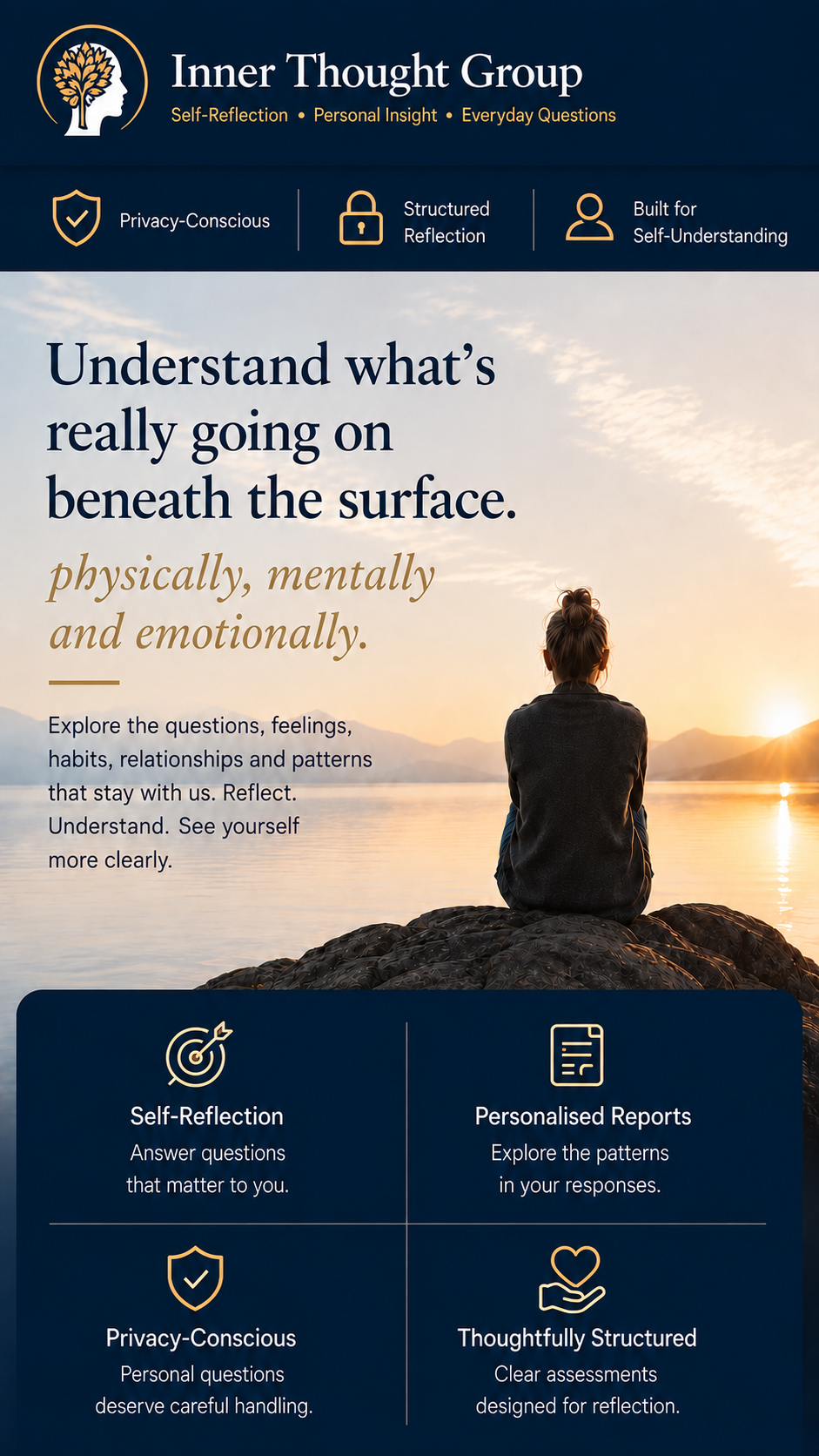
Helping people understand what they think, feel and hold onto
Physically, mentally and emotionally.
Why Inner Thought Group exists
Inner Thought Group is built around a simple idea: people often carry things with them long after the original moment has passed.
Sometimes that means possessions. Sometimes it means memories, relationships, fears, worries, habits, resentment, uncertainty, self-doubt or unanswered questions.
Our aim is to help people explore those patterns through structured self-reflection assessments, practical articles and personalised insight reports designed to make complicated thoughts and feelings easier to understand.
From holding onto possessions to holding onto much more
The site originally began with a focus on hoarding and the difficulty of letting go of physical possessions.
That led to a broader question: what else do people hold onto?
Inner Thought Group grew from that question. Today, the site explores a much wider range of everyday emotional, behavioural and personal questions while keeping the original idea of “holding onto” as part of its history and identity.
Reflection rather than labels
The aim is not to reduce complicated thoughts and feelings to a simplistic label.
Start with real questions
Many people arrive because they have been quietly wondering something about themselves. We use those real questions as the starting point for structured self-reflection.
Look at patterns
Where appropriate, assessments consider several dimensions so a result can reflect nuance, mixed patterns and competing themes rather than relying on a single yes-or-no answer.
Encourage understanding
The goal is to help visitors recognise possible patterns in their thoughts, emotions and behaviour without judgement, shame or unnecessary certainty.
What we explore
Inner Thought Group covers a broad range of everyday questions across:
A platform for practical self-understanding
Inner Thought Group is an independent educational and self-reflection platform focused on helping people explore personal questions in a structured and thoughtful way.
It is not a medical clinic, therapy service, university, professional regulator or diagnostic organisation.
An important distinction
Hoarding disorder is a recognised mental-health condition and should not be trivialised or treated simply as a metaphor.
When Inner Thought Group discusses hoarding specifically, we aim to distinguish clinical hoarding from the broader everyday idea of holding onto thoughts, memories, emotions, relationships or habits.
Our self-reflection assessments are educational tools and are not intended to diagnose hoarding disorder or any other medical or mental-health condition.
About our assessments and reports
Inner Thought Group assessments are designed to support self-reflection rather than provide clinical conclusions.
Responses may be considered across several dimensions, allowing a report to show where particular themes appear stronger, weaker or mixed.
Personalised report wording is intended to help explain those patterns in plain language while avoiding diagnosis, certainty and unnecessary labels.
Privacy and personal questions
Many of the questions explored on Inner Thought Group are personal. Privacy-conscious design, responsible data handling and clear information about how report data is processed are therefore important parts of the platform.
You can read more about how information is handled in our
Privacy Policy
.
Start with the question that matters to you
Browse Inner Thought Group assessments and explore the topics that feel most relevant to what you are experiencing.